Call now: 252-767-6166  
Oracle Training Oracle Support Development Oracle Apps

Free Oracle Tips

HTML Text

 Home
 E-mail Us
 Oracle Articles


 Oracle Training
 Oracle News

 Oracle Forum
 Class Catalog


 Our Staff
 Our Prices
 Help Wanted!

 Remote DBA
 Oracle Tuning
 Emergency 911
 RAC Support
 Apps Support
 Analysis
 Design
 Implementation
 Oracle Support


 SQL Tuning
 Security

 UNIX
 Oracle UNIX
 Linux
 Oracle Linux
 Monitoring
 Remote help

 Remote plans
 Remote
services
 Oracle C++
 Oracle Java
 Apache
 JDeveloper
 App Server

 Applications
 Oracle Forms
 Oracle Portal
 11i Upgrades
 SQL Server
 Oracle Concepts
 HTML-DB Tips
 Software Help

 Remote Help  
 Development  

 Implementation


 Financials Training
 Oracle 11i
 Oracle Apps 11i
 Oracle Workflow
 Oracle AR 11i Class
 Oracle AP 11i class
 Oracle GL 11i class
 Oracle HR 11i class
 Oracle FA 11i class
 11i Project Mgt
 11i procurement
 11i collections


 Oracle Posters
 Oracle Books

 Oracle Tuning Book
 Oracle RAC Book
 Oracle Security
 Easy Oracle Books
 Oracle Scripts
 SQL Server DBA
 SQL Design Patterns
 Ion
 Excel-DB   


 BC Oracle News


 Rednecks!
 Dress code
 Arabian Stallion

 Burleson Arabians
 Guide Horses
 Don Burleson Blog
 Golf & Travel


 Privacy Policy


Adjusting Array Size in Oracle SQL*Plus

Oracle Tips by Burleson Consulting


The default ARRAYSIZE in SQL*PLus is 15. This will show up during the analysis of the trace files by dividing the number of rows returned by the number of SQLNet roundtrips as the default size being using in the application. The ARRAYSIZE specifies the number of rows to return when returning a set of values to the application. Since this specifies the array size to return, it directly impacts the number of round trips required to satisfy a request for data.

I ran a series of select statements using the SQL*Plus interface to a development environment and varied the ARRAYSIZE starting at 5 and working up to 200 in increments of five. The following chart shows the results for the example select statement:

SELECT * FROM dba_objects;

I utilized the SET AUTOTRACE ON STATISTICS and SET TIMING ON commands to gather statistics on net round trips and time required to satisfy the select statement.
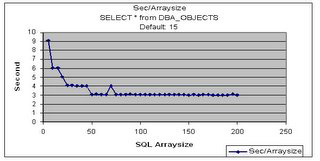
As you can see the benefits for this select statement fall off after an ARRAYSIZE of 50 is reached. A plot of the roundtrips verses ARRAYSIZE tells why. In the following chart of roundtrips verses ARRAYSIZE setting you see that at 50 the value for roundtrips is 147 having reduced from the high of 1606 by 90%, from array sizes 50 to 200 it only decreases to 42 a change of only 10% (based on the original 1606) fewer roundtrips.
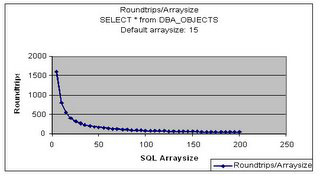
This indicates we need to adjust the ARRAYSIZE being used to retrieve data from the Oracle database, by doing so we can dramatically reduce the number of network roundtrips. In this environment where our latency is very small, you can see the change of ARRAYSIZE from a default value of 15 to a size of 50 reduced the time it took to retrieve the data from the select statement from 6.03 seconds to 3.07 seconds, nearly a 50 percent decrease in elapsed time and a reduction in network roundtrips of over 90 percent. This was on a local database with 4 ms latency imagine what a difference it would make when latency is 50 to 100 times this latency?

Where this can be of real benefit is in a Java situation. To set the array size, use the setDefaultRowPrefetch method of the OracleConnection class. However, the size should be determined empirically by setting the size and running test runs because this is a case of diminishing returns as the array size gets larger. Also, the size of network buffers and packets need to be factored in when sizing the buffers in SQL.



 Oracle cruise


Oracle performance tuning software


Oracle performance tuning book


Oracle performance Tuning 10g reference poster


Oracle training in Linux commands
 
Oracle training Excel
 
Oracle training & performance tuning books


Burleson is the American Team

Note: This Oracle documentation was created as a support and Oracle training reference for use by our DBA performance tuning consulting professionals.  Feel free to ask questions on our Oracle forum.

Verify experience! Anyone considering using the services of an Oracle support expert should independently investigate their credentials and experience, and not rely on advertisements and self-proclaimed expertise. All legitimate Oracle experts publish their Oracle qualifications.

Errata?  Oracle technology is changing and we strive to update our BC Oracle support information.  If you find an error or have a suggestion for improving our content, we would appreciate your feedback.  Just  e-mail:  and include the URL for the page.


Burleson Consulting

The Oracle of Database Support

Oracle Performance Tuning


Remote DBA Services


Copyright © 1996 -  2009 by Burleson Enterprises, Inc. All rights reserved.

Oracle © is the registered trademark of Oracle Corporation.