 |
|
Using RAID5 with Oracle?
Oracle Tips by Burleson Consulting |
Update - 2 February 2007
We need to note that RAID5 is only a problem for database
with high DML activity, and many disk vendors have made advances that
overcome the "write penalty" associated with high update activity.
One such product is the
Hitachi TagmaStore
RAID5 "Universal Storage Platform". In a nutshell, the
TagmaStore device uses a large 256GB cache to overcome the RAID5 write
penalty. Because this cache is so huge, the database can write to disk
and move on; the parity is calculated from the data in cache
asynchronously. So unless the cache is over-extended, the database will
not suffer the RAID 5 write penalty.
The TagmaStore documentation notes:
"Cache memory is memory used to perform
data read/write processing efficiently between front-end and back-end
directors. The cache capacity on both sides is configured to be a minimum of
4GB, to a maximum of 256GB, with expansion in units of 4GB or 8GB.
The disk controller performs control so
that there is always the most efficient use of the cache in response to data
access patterns, thus obtaining a highly stable level of performance.
As an optional expansion, access paths to the cache can be doubled to obtain
internal data trans-mission capacities in combination with a cache switch
for a maximum of 68GB/sec."
No RAID5 for Oracle
December 9, 2003
RAID 5 is universally discouraged for all Oracle database except
(read-only Oracle databases) because of the huge update penalty.
Of course, database with low volumes of DML (inserts, updates) may use
RAID5, so long as update response time is acceptable.
Oracle officially recommends the SAME approach (Stripe And Mirror
Everywhere), essentially RAID O+1 with segregation of undo/redo and
rollbacks on separate spindles.
Many of the
world's most widely-read Oracle experts have become frustrated with the vendors
pushing RAID-5 for Oracle. To stop this onerous practice, they
started the Battle Against Any RAID Five (BAARF) initiative: According to the
BAARF charter:
"The reason for BAARF is that we?ve had it. Enough is
Enough. For 15 years a lot of the world?s best database experts have
been arguing back and forth with people (vendors and others) about the
pros and cons of RAID-3, -4 and -5."
Among the BAARF member are some of the world's leading Oracle experts
and authors:
-
Cary Millsap
- Wrote articles against
RAID-5 many years ago.
-
Tim Gorman
- Founder of People's Front
for the BAARF
-
James Morle - Author of
Sane SAN
-
Anjo Kolk - Has placed the
BAARF logo on OraPerf.com
-
Rachel Carmichael - I've
been fighting RAID-F for what seems like forever. Not usually winning,
but fighting. Mine not to reason why, mine but to fight and die.
-
Brian Peasland - I've been
fighting Raid-F for many, many years now. I currently have a
multi-terabyte system which we want redundancy, but the powers-that-be
won't fork over the cash for RAID 1 or RAID 0+1. So RAID 5 it is. I told
them that data loads would take twice as long. And sure enough, they do.
But they still insist on RAID 5 as the RAID level of choice. Ugh........
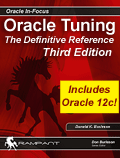 |
If you like Oracle tuning, see the book "Oracle
Tuning: The Definitive Reference", with 950 pages of tuning tips and
scripts.
You can buy it direct from the publisher for 30%-off and get
instant access to the code depot of Oracle tuning scripts. |



 and include the URL for the page.